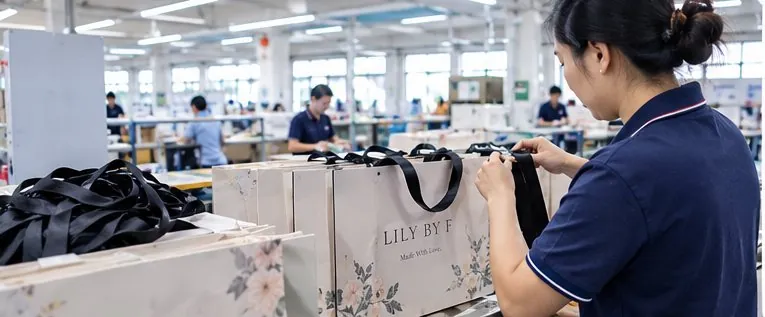
The handle is where a paper bag fails first, and it is the single cheapest place to prevent a complaint. Five types cover almost every order: twisted paper cord (5–8 kg, all-paper), flat paper strip (4–7 kg, premium look), die-cut hole (2–4 kg, cheapest), cotton or polyester rope (8–15 kg, strongest) and satin ribbon (3–5 kg, gifting).
What actually decides whether a handle survives is not the handle alone — it is the reinforcement under it, the distance from the hole to the bag's top edge, the glue grade, and whether the handle length matches the bag width. Those four numbers are below.
The five handle types
Twisted paper handle
Kraft or white paper twisted into a cord, glued into the bag's top turn-over with a paper patch inside the bag to spread the load. It is the default for retail paper bags because it is entirely paper — bag and handle recycle together — and because the cord is strong for its weight. Standard diameters run 3–5 mm; the 5 mm cord is what we use when a bag will carry bottles or canned goods. Colour options are white, kraft, black and matched Pantone, though dark cords on light bags can mark the paper if the bag is stored damp.
Flat paper handle
A flat paper strip, usually 10–15 mm wide with a twisted-paper core inside, glued under the top fold. It lies flat against the bag in transit, which cuts carton volume, and it does not dig into the hand the way a thin cord can. It reads as more premium than a twisted cord at a modest cost increase, which is why cosmetics and fashion packaging tend to use it. The trade-off is that the glue area is a flat strip rather than a cord end, so surface contamination on the bag's top fold is less forgiving.
Die-cut handle
A hole punched through the bag's own paper, no added material. It is the cheapest handle by a wide margin and the only one that adds nothing to the material list. It only works on light loads — apparel, accessories, single cosmetics items — and it needs a reinforced top: either a top turn-over of two or three paper layers, or a cardboard insert glued inside. A die-cut handle on a 100 gsm bag with no reinforcement will tear out on the first carry, usually at the corner of the punch.
Cotton or polyester rope handle
Rope, typically 4–6 mm, knotted inside the bag through a punched hole, sometimes with metal or paper eyelets. This is the strongest option and the one used for heavier retail, shoes, and anything over about 6 kg. It is also the least recyclable in practice, because the rope has to be separated from the paper before the bag goes into the paper stream. Polyester rope is stronger and cheaper than cotton; cotton takes dye better and feels softer in the hand.
Satin or grosgrain ribbon handle
Ribbon, 10–25 mm, glued under the top fold or threaded through eyelets. Purely a gifting specification: it carries light loads and its value is entirely visual. Cut ends must be heat-sealed, or the ribbon will fray along the fold within days. On a 200 gsm bag the ribbon looks generous; on a 250 gsm bag with a heavy print it can look weak, so ribbon orders usually pair with a lighter paper than a cord order would.
Side-by-side comparison
| Handle | Typical load per bag | Relative cost | Best for | Watch out for |
|---|---|---|---|---|
| Twisted paper cord | 5–8 kg | 1.0× (baseline) | Retail, apparel, food & beverage | Dark cord can mark light bags in damp storage |
| Flat paper strip | 4–7 kg | 1.3–1.6× | Cosmetics, fashion, gifting | Glue area is flat — needs a clean top fold |
| Die-cut hole | 2–4 kg | 0.2–0.4× | Apparel, light accessories, events | Must have reinforced top or it tears out |
| Cotton / polyester rope | 8–15 kg | 1.4–1.8× | Footwear, bottles, heavier retail | Mixed material — recycling is conditional |
| Satin / grosgrain ribbon | 3–5 kg | 1.5–2.2× | Gift bags, premium unboxing | Ends fray unless heat-sealed |
The cost column is relative to a twisted paper cord at the same quantity, and it is a range because the handle is a small share of a bag's cost. On a 250 gsm bag with four-colour print, moving from a die-cut hole to a twisted cord typically adds a few percent to the unit price, not a step change — which is why the handle is usually the wrong place to save money.
What "load rating" actually means
The numbers above are working loads, not breaking loads. In practice a paper bag is specified with roughly a 2:1 safety factor, so a bag rated at 5 kg should survive about 10 kg in a static test — but static tests flatter paper bags. Walking with a bag swings the load, and a swinging bag puts several times the static force through the handle attachment twice per step. A bag that holds 10 kg hanging still can fail at 4 kg being carried down a street.
Weight distribution matters as much as total weight. Two bottles at either end of a wide bag torque the top fold in a way that a single dense item in the centre does not. If your product is heavy and wide, spec the next handle grade up and add a full-width cardboard insert, which costs very little and converts a two-point load into a distributed one.
Paper weight and handle grade have to be chosen together. A 5 mm twisted cord on a 120 gsm bag will not tear at the handle — it will tear the bag's top edge out around the handle. The usual minimum pairing we quote is 150 gsm paper with a twisted cord, 170–200 gsm with a flat handle or rope, and 210 gsm and above with a die-cut handle that has to survive handling.
Four ways a handle fails
Glue failure in the cold. Standard hot-melt adhesive gets brittle below roughly −5 °C. A bag that is glued, packed and shipped in winter can arrive with handles that peel off in the customer's hand, and the failure looks like a manufacturing defect even though it is a specification mismatch. If the bags will travel through a cold chain or sit in an unheated warehouse, ask for a cold-resistant adhesive grade. It costs a little more and it is not always offered unless you ask.
The hole is too close to the top edge. The distance from the punch or glue line to the bag's top edge should be at least 15 mm on a die-cut bag, and 20 mm is safer. Below that there is not enough paper between the load and the edge, and the top edge peels open. This is the single most common cause of a die-cut failure, and it is decided on the die drawing, long before production.
No reinforcement under the attachment. Handles pull on a small area of paper. A top turn-over of at least 30 mm, or a glued cardboard patch, spreads that force across the bag's full width. On bags above 250 mm wide, a patch is effectively mandatory: the wider the bag, the more the load concentrates at the two handle points as it swings.
Wrong handle length for the bag. Too short and the bag tips against the leg; too long and the bag hangs low and looks slack. Handle length is also a comfort issue — a cord under 3 mm digs into the hand when the bag is full, which is why heavier bags move to rope or flat strip rather than a thicker cord.
Handle length and drop length
Two numbers, both worth writing into the purchase order in millimetres.
- Total length — end to end, before gluing. 380–420 mm for bags up to 300 mm wide; 300–340 mm for small bags under 200 mm wide.
- Drop length — from the bag's top edge to the top of the handle standing up. 90–120 mm is the comfortable range for hand carry; below 80 mm the bag hits the leg, above 130 mm it reads as a shopping tote rather than a retail bag.
- Handle spacing — distance between the two attachment points, usually 55–70% of the bag's width. Wider spacing stabilises the bag; narrow spacing lets it swing.
- Cord diameter or strip width — 3–5 mm cord, 10–15 mm flat strip, 10–25 mm ribbon, 4–6 mm rope.
If you are matching an existing bag, the fastest route is to send us the bag itself or a photo with a ruler across the handle. Measuring from a photo without a scale is where most handle reorders go wrong, because a 10 mm difference in drop length is visible in the hand but invisible in a picture.
Recyclability, market by market
Paper handles are the simplest story: twisted cord, flat strip and die-cut holes are all paper, so the whole bag goes into the paper stream with no disassembly. Rope and ribbon handles break that, and how much it matters depends on where you sell.
In the European Union, packaging is moving under extended producer responsibility rules with fee modulation by recyclability, and several member states already apply stricter sorting guidance. A glued-in rope handle is a material the consumer is expected to remove, and most will not — so an all-paper handle is the specification that survives a compliance review with the least argument. In the United States, the position varies by municipality, and "please remove handle before recycling" is a common label fix rather than a design fix. In the Gulf and much of Southeast Asia, where incineration and landfill still dominate, handle material has little practical effect and appearance matters more.
The pragmatic rule: if your brand makes a recyclability claim on pack, keep the handle paper. If the bag is a gift bag that will be reused for years, rope or ribbon is a reasonable choice — a bag that is reused is better than a bag that is recycled.
What to send with an inquiry
Handle specification is five lines. Send these and a quotation is usually same-day:
- Product weight and shape — what goes in the bag, and whether it swings or sits
- Handle type, or the look you want and let us match it
- Bag size (W × H × D in mm) and paper weight in gsm
- Handle colour — white, kraft, black, or a Pantone reference
- Destination market and shipping mode — this decides whether you need a cold-resistant adhesive and whether recyclability will be audited
If you have a sample of a bag you like, send a photo with a ruler next to the handle. It answers half of the questions above in one image.
Handles are quoted with the bag, not after it
We make bags, handles, boxes and tags in the same plant in Dongguan, which means the handle is chosen while the paper weight is still open. That is the point in the process where a specification change is free — after the die is cut, it is a new run.
Send the product, the bag size and the market you sell into. We will come back with the handle grade that carries it, the paper weight that supports that handle, and what the whole thing costs at your quantity.
Common questions
Which paper bag handle is the strongest?
A cotton or polyester rope handle set into a reinforced top fold is the strongest option we run, typically carrying 8–15 kg per bag depending on paper weight and reinforcement. Twisted paper cord is next at roughly 5–8 kg and is the usual choice for retail because it is all-paper and recycles in the normal paper stream. Flat paper handles carry around 4–7 kg, die-cut handles 2–4 kg, and satin ribbon handles 3–5 kg. The handle is rarely the limiting factor on its own: an unreinforced bag top will tear before the handle breaks, which is why a top fold or cardboard insert matters as much as the handle type.
What handle length should I specify for a paper bag?
Two numbers matter. Total handle length is measured end to end and is typically 380–420 mm for a bag up to 300 mm wide, which lets an adult hand pass through comfortably. Drop length is measured from the bag's top edge to the top of the handle when it stands up, and usually sits at 90–120 mm; shorter than that and the bag hits the leg when carried, longer and it looks slack on the shelf. For children's products or small bags under 200 mm wide, drop the total length to 300–340 mm rather than scaling the bag proportionally.
Are cotton rope handles recyclable?
The bag is, but the handle is the problem. A paper bag with a paper handle — twisted, flat or die-cut — goes into the paper stream as a single material. A cotton or polyester rope handle, or a plastic handle, is a second material glued into the paper, and many municipal paper mills treat it as contamination; the consumer has to pull it out first, and most do not. In markets moving under extended producer responsibility rules, all-paper handles are the safer specification. If you need the rope look, spec a paper cord that mimics rope, or accept that recyclability is now conditional on the end user's behaviour.