Custom-printed paper bags typically start at 500 to 3,000 pieces per design. Plain kraft bags with one-colour printing sit at the bottom of that range; laminated bags with foil, embossing or special handles sit at the top. Our own MOQ is 1,000 pieces per design.
Below about 500 pieces the economics stop working on a production line — but there are five legitimate ways to get closer to your real quantity without paying sample-run prices.
1. Why the minimum exists
An MOQ is not a sales tactic. It is the point where the fixed costs of a production run stop dominating the price of each bag. There are four of them:
- Paper comes in large units. Paper mills sell in reels or large sheets. For a small order, a factory buys cut-down stock at a premium, or throws away the leftover of a full reel. Either way you pay for more paper than your order needs.
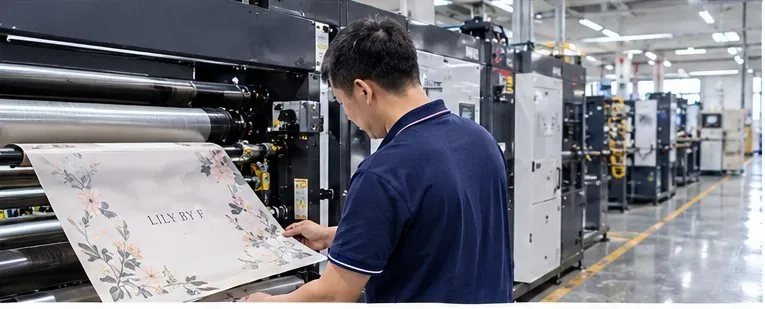
- Printing setup is one-time and real. Flexo requires a cylinder per colour; offset requires a plate per colour plus make-ready sheets while the press is dialled in. Ten colours of setup cost the same whether you print 500 bags or 50,000.
- Die-cutting needs a die. A cutting die is machined to your size. It is a fixed cost that gets spread across the run.
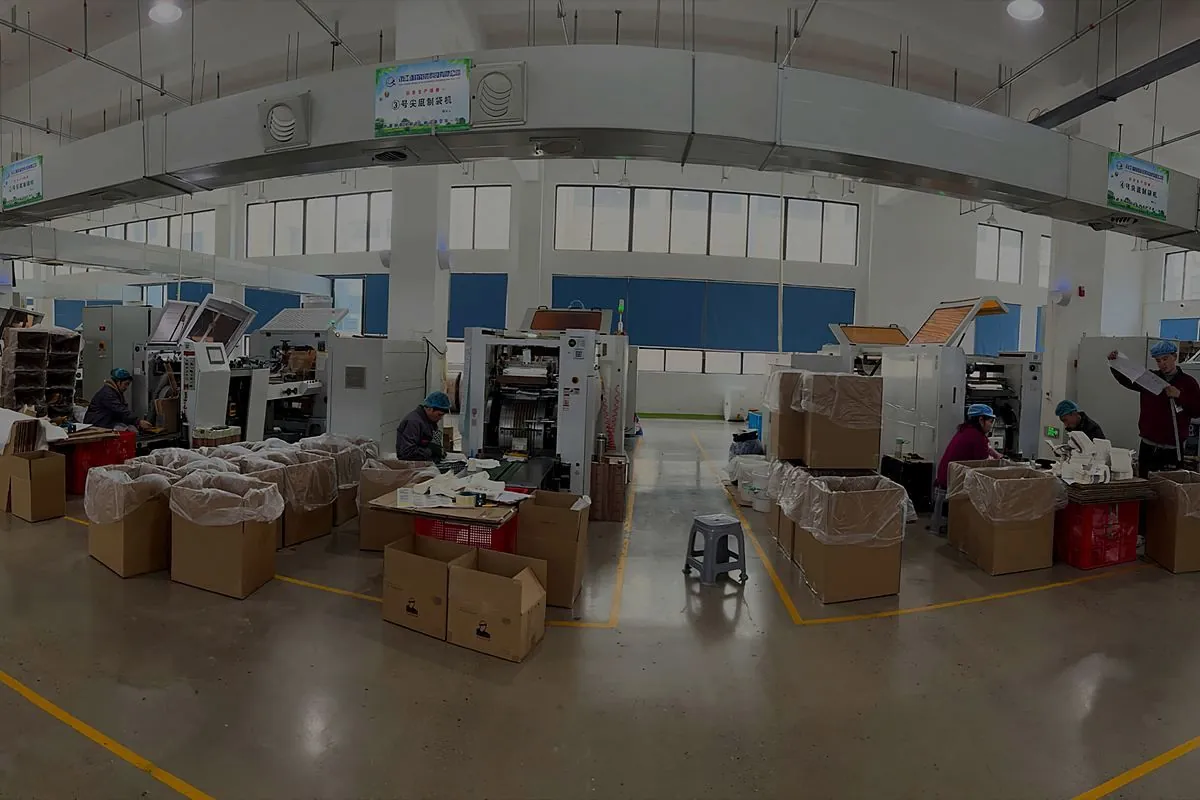
- Bag machines are fast, and starting them is slow. A bag machine produces hundreds of pieces per minute. Setting it up, threading paper, adjusting glue and running test pieces takes one to two hours. Run it for eight minutes and you have spent more time setting up than producing.
Add the start-up waste — typically a few percent of the run before the glue and registration settle — and you can see why 300 bags costs almost as much to make as 1,000.
Each of those four items is a line in your unit price. All seven lines are broken down in Custom Packaging Cost Breakdown.
2. MOQ by bag construction
These are the ranges we see across the industry in Dongguan. Treat them as orientation, not as an offer — the exact number depends on size, paper and colour count.
| Construction | Typical MOQ | What drives the number |
|---|---|---|
| Stock kraft bag, one-colour print | 500–1,000 | Stock size and stock paper; print is the only custom step |
| Printed kraft, 2–4 colours, custom size | 1,000–2,000 | New die for the size, one cylinder per colour |
| Laminated art paper shopping bag | 1,000–2,000 | Lamination is a separate pass with its own setup |
| Luxury bag with foil, emboss or spot UV | 2,000–3,000 | Each finishing step has its own die or plate |
| Wine or bottle bag | 1,000 | Reinforced base board and taller die-line |
| Die-cut handle bag | 1,000 | Handle is part of the die, no separate handle line |
3. Five ways to lower your effective MOQ
Use a stock size and stock paper
The single biggest lever. If your design fits a size the factory already has a die for, you skip die-making and often can buy paper from existing stock. Ask for their standard size list before you design.
Cut the number of colours
Each colour is a cylinder or plate plus one more registration to hold. Reducing four spot colours to two can drop the MOQ by a third at the same unit cost.
Drop one finishing step
Foil, embossing and spot UV each add a die and a pass through a separate machine. Keeping foil and losing emboss often gets you under a threshold.
Combine sizes, not designs
Small, medium and large in the same artwork and paper are one design — the paper and print setup are shared. Three different artworks are three designs, each with its own minimum. Design a family, not three individual bags.
Accept a longer lead time or a slot-filler
A factory running your paper anyway may slot a small order in behind a large one, sharing the setup. It costs you flexibility on the delivery date, and you have to ask for it explicitly — but it is the cheapest route to a low quantity.
4. How unit cost moves with quantity
The decline is steep at first, then flattens. The table below is an index, not a price: unit cost at the MOQ is set to 100. It illustrates the shape of the curve for a typical laminated shopping bag.
| Quantity | Unit cost index | What you are buying |
|---|---|---|
| 1× MOQ (1,000) | 100 | Full setup cost spread over the minimum run |
| 2× MOQ (2,000) | ≈ 78 | Same setup, twice the paper and machine time |
| 5× MOQ (5,000) | ≈ 64 | Setup now a small share of the total |
| 10× MOQ (10,000) | ≈ 58 | Mostly paper and machine time; curve nearly flat |
The practical lesson: doubling from the MOQ usually saves a meaningful percentage; going from 5,000 to 10,000 saves much less than people expect. Stock that sits in a warehouse for a year is not a saving.
5. When paying more per bag is the right call
- Testing a market. 1,000 bags at a higher unit cost beats 10,000 bags in a colour nobody bought.
- Seasonal or limited editions. A holiday print that will be obsolete in eight weeks should not be ordered at ten times the minimum.
- Cash flow. The cheapest unit price is irrelevant if the inventory eats the working capital you need for the next collection.
- Storage. Paper bags are bulky. Ten thousand laminated bags occupy real warehouse space and must stay dry — humid storage makes laminated paper curl at the edges.
6. What to confirm in writing
- MOQ per design, with the exact definition of what counts as one design.
- Whether the sample fee is credited back, and at what order quantity.
- A price-break table at 1×, 2×, 5× and 10× the MOQ — ask for it before you choose a quantity.
- Whether tooling (die, cylinders) is charged separately or included, and who owns it afterwards.
- Packing quantity per carton, because carton count drives freight cost as much as bag count does.
Frequently asked
Can I order fewer than 1,000 custom paper bags?
Usually yes, but the pricing model changes. Below roughly 500 pieces most factories treat the order as a sample run, which means hand or short-run production and a much higher unit cost. If you need a small quantity to test a market, it is cheaper to pick a stock size and stock paper and accept a plain or single-colour print.
Is MOQ per design or per order?
Per design. Three sizes in the same artwork and paper count as one design and can be combined; three different prints count as three designs and each carries its own minimum. Always confirm this in writing before you assume the total order size is what triggers the better price.
Does a bigger order always mean a cheaper unit price?
Unit price falls steeply up to about five times the MOQ, then flattens. Beyond that point you are mostly buying paper and machine time at market rates, so the curve is close to linear. Ordering ten times the MOQ to chase a 5% saving usually costs more in storage and cash flow than it saves.