A custom-printed paper bag is built from seven cost lines: paper, printing, converting into a bag, finishing, packing, inland transport and the factory's margin. At 1,000 pieces, paper and setup together are usually 60–75% of the unit price. At 50,000 pieces the setup fades and paper alone can exceed half.
So when one quotation is 40% cheaper than another, the difference is almost never efficiency. It is a lighter paper, fewer colours, a finishing step removed, freight excluded — or all four. This guide shows you which line to look at, and what to ask before you sign.
1. The seven lines on a quotation
Most suppliers send a single unit price. Underneath it there are seven lines. The shares below are typical ranges across the industry at around the MOQ, not a price list — they shift with construction, paper grade, colour count and quantity.
| Cost line | Share of unit price | What moves it |
|---|---|---|
| Paper | 35–50% | Grade, grams per square metre, reel price, wastage |
| Printing | 12–25% | Colour count, cylinder or plate cost, run length |
| Converting | 15–22% | Bag type, handle type, machine speed, hand work |
| Finishing | 0–20% | Lamination, foil, emboss, spot UV — one pass each |
| Packing and cartons | 3–6% | Pieces per carton, carton grade, pallet |
| Inland transport | 1–3% | Distance to Shenzhen or Guangzhou port |
| Factory margin | 8–15% | Order size, payment terms, how busy they are |
The ranges overlap on purpose: raise the paper grade and its share grows while everything else shrinks. Add lamination and finishing eats a fifth of the price. Cut the quantity and printing's share jumps, because setup is spread over fewer bags.
2. Paper — the biggest and most volatile line
Paper is a commodity sold by weight, and it is the one line that can change without anyone deciding to change it. Mills publish reel prices; when pulp moves, your quotation moves, usually with a few weeks' notice.
Grams per square metre is where the money hides
A shopping bag in 150 gsm kraft feels substantial; the same bag in 120 gsm saves roughly a fifth of the paper cost and feels noticeably flimsier in the hand. Buyers who compare two quotations without comparing gsm are comparing two different products. Always ask for the gsm in writing.
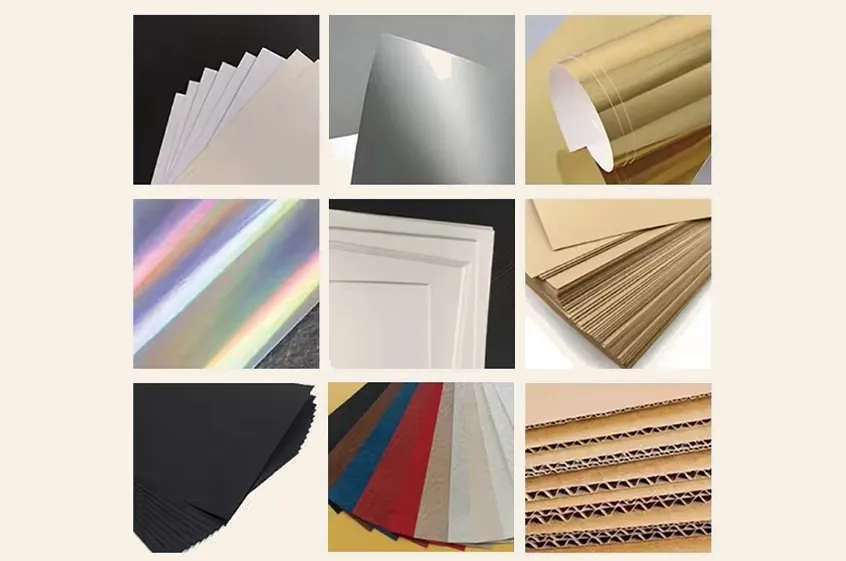
- Kraft — cheapest per tonne among common grades, natural brown, prints best in one or two colours. See kraft vs art paper vs coated for how each behaves.
- Art paper — coated, smooth, holds photographic print. Higher cost, but the only choice when the artwork has gradients or images.
- Coated or laminated — art paper plus a film. You are paying for the film and a separate lamination pass, not for better paper.
- Grey board or rigid board — for gift boxes, priced by thickness rather than gsm.
Wastage is a real line
Nobody can print on every square metre of a reel. Trim loss, edge damage and start-up waste typically add 3–8% to the paper a job actually consumes. A quotation that looks like it charges you for exactly the paper in the finished bags is either absorbing that or planning to substitute something lighter.
3. Printing — why setup rules small orders
Printing has two parts: a fixed setup and a running cost per bag.
- Flexo needs an engraved cylinder per colour. Cylinders are machined to the repeat length of your artwork, cost real money, and are yours to reuse on the next order.
- Offset needs a plate per colour plus make-ready — typically a few hundred sheets run as waste while the press operator dials in registration and ink density.
Setup cost does not care how many bags you print. Ten colours of setup costs the same for 500 bags as for 50,000. That single fact explains almost the whole shape of the quantity-price curve — which is why MOQ and the cost curve are the same subject seen from two sides.
Rule of thumb: every colour you remove takes a cylinder, a registration and a slice of make-ready waste with it. Four colours down to two is usually worth more than shopping for another supplier.
For genuinely small runs, digital or short-run printing removes the cylinder entirely and raises the per-bag running cost. It is not cheaper overall — it is cheaper at that quantity, and it only works on flat sheet or label work, not on a bag printed in line with the bag machine.
4. Converting — the labour nobody quotes
Turning printed paper into a bag is where a factory's actual skill sits, and it is the line most buyers never see. It includes:
- Die-cutting — a machined die for your size, then cutting the printed sheets.
- Bag making — side gussets or flat, bottom fold, glue application, all at machine speed.
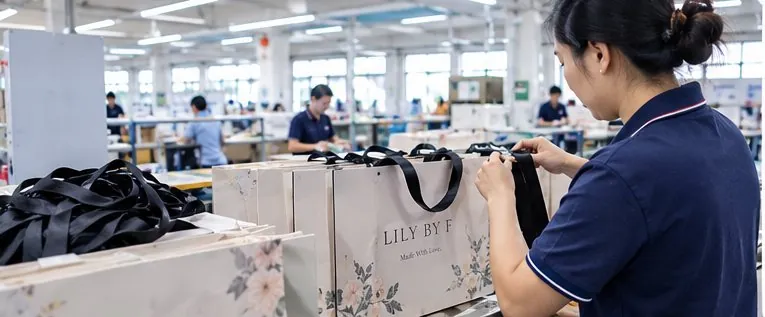
- Handles — twisted paper handle, flat paper handle, ribbon, die-cut, or rope. Each has its own machine or its own jig, and hand-attached handles are the single biggest labour item in a luxury bag.
- Reinforcements — top turn-over card, base board, eyelets. Small parts, real minutes.
This is also where quality differences live. Two factories can quote the same paper and the same print and differ by 15% here, because one runs the bag machine slower, glues more generously, and inspects at the end of the line rather than at the carton.
5. Finishing — each step is a separate pass
Every finishing step means the job leaves the main line, queues for a different machine, gets set up, and comes back. Each pass adds its own handling loss — usually 1–2% of the run.
| Finishing step | What it adds | Cost driver |
|---|---|---|
| Matte or gloss lamination | Water resistance, stiffness, colour depth | Film cost plus a full separate pass |
| Foil stamping | Metallic logo or border | A metal die plus a hot-stamp pass |
| Embossing or debossing | Raised or recessed texture | A matched die pair plus a press pass |
| Spot UV | Gloss pattern on a matte surface | A screen or plate plus a coating pass |
| Soft-touch coating | Velvet hand feel | Coating material plus a pass, and slower drying |
Note the pattern: the material is rarely the expensive part. The pass is. This is why dropping one finishing step often saves more than switching to a cheaper paper — and why a design with three finishing steps can cost twice what the paper inside it costs.
6. Packing, cartons and freight
Packing is 3–6% of the unit price and can quietly double your landed cost. Two reasons:
- Carton count drives freight as much as bag count does. Laminated bags do not compress; a carton holds fewer of them than you expect. Fifty pieces per carton instead of eighty means 60% more cartons for the same order.
- Shipping is billed on volume, not weight. Paper bags are light and bulky, so sea freight is charged on cubic metres. Reducing carton size by 5 cm on each dimension can remove a whole pallet from a container.
For a small first order, freight can exceed the value of the goods. This is exactly why comparing FOB unit price across suppliers is misleading — compare landed cost at your door, including duty, or you are choosing between two numbers that do not measure the same thing.
7. What the factory actually keeps
Export paper packaging runs on thin margins: 8–15% is a normal band, and the low end is common on large orders from experienced buyers. That has two practical consequences.
- A quotation 25% below everyone else is not a better deal — it is a different specification, a subcontractor with no visibility of the line, or a price that will be recovered later through a "material surcharge".
- A factory at 3% margin has no room to absorb a mistake. When something goes wrong, the cheapest supplier is the one most likely to substitute paper or ship short rather than re-run the job.
Tooling is usually outside the margin conversation. Cylinders and dies are often charged separately, and ownership should be confirmed in writing — they are reusable on your next order, and a supplier who keeps them has a reason to want you to come back.
8. How to read a quotation
Six questions turn an opaque number into something you can compare.
- Paper grade and gsm, written down, per component — body, handle, reinforcement board.
- Colour count and ink system — and whether white ink or a primer is included, because printing on brown kraft needs one.
- Full finishing list, itemised, so you can remove one and see the saving.
- Tooling — cost, whether it is included, and who owns the cylinders and die afterwards.
- Carton packing quantity and total CBM, so you can cost freight before you commit.
- Price break table at 1×, 2×, 5× and 10× the MOQ. If a supplier will not give you one, they are pricing by feel.
Then compare landed cost per bag, not the FOB number. That single change in method usually reorders the shortlist.
Our own numbers, for reference: MOQ 1,000 pieces per design, samples in 3–5 days, production 10–20 days after approval, and a written price-break table on request. No tooling surprises — we tell you the cylinder and die cost before you decide.
Frequently asked
Why are custom printed paper bags so much more expensive than stock bags?
Because a stock bag only carries the material and machine time of a run that already exists. A custom bag adds a new die for the size, one printing cylinder or plate per colour, make-ready waste while the press is dialled in, and a separate pass for every finishing step. Those setup costs are fixed, so they dominate the price at low quantities and fade away at high ones. At 1,000 pieces setup can be a third of the unit price; at 50,000 it is a rounding error.
Why do two factories quote prices that are 40 percent apart for the same bag?
Almost never because one is generous. The gap is usually a different paper weight or grade, a different ink system, one factory counting freight or tooling and the other not, a different carton packing quantity, or a subcontractor quoting on top of a factory price. Before comparing numbers, compare the written spec: paper grade and grams per square metre, number of colours, finishing list, carton quantity, and whether tooling and freight are included.
What is usually not included in a paper bag quotation?
Tooling is often quoted separately: printing cylinders or plates, and the cutting die. Freight and insurance are usually quoted separately from the FOB unit price. Also commonly excluded are artwork separation and retouching, third-party inspection fees, destination duties and taxes, storage or demurrage at the port, and the cost of re-making a die when you change the bag size. Ask for a line-by-line list of exclusions before you compare offers.