Judge a paper bag supplier on four things you can verify without trusting their brochure: whether the machines are theirs, whether a physical sample matches the quote, who is accountable when something goes wrong, and whether the price breakdown makes sense. Everything else — website, catalogue, factory photos — is marketing that anyone can copy.
Below is the checklist we would use ourselves if we were buying 20,000 bags from an unknown supplier.
1. Factory or trading company?
Both are legitimate businesses. The problem is paying factory prices for trader service, or expecting factory-level flexibility from a company that has to re-quote everything with a third party.
Three checks that are hard to fake:
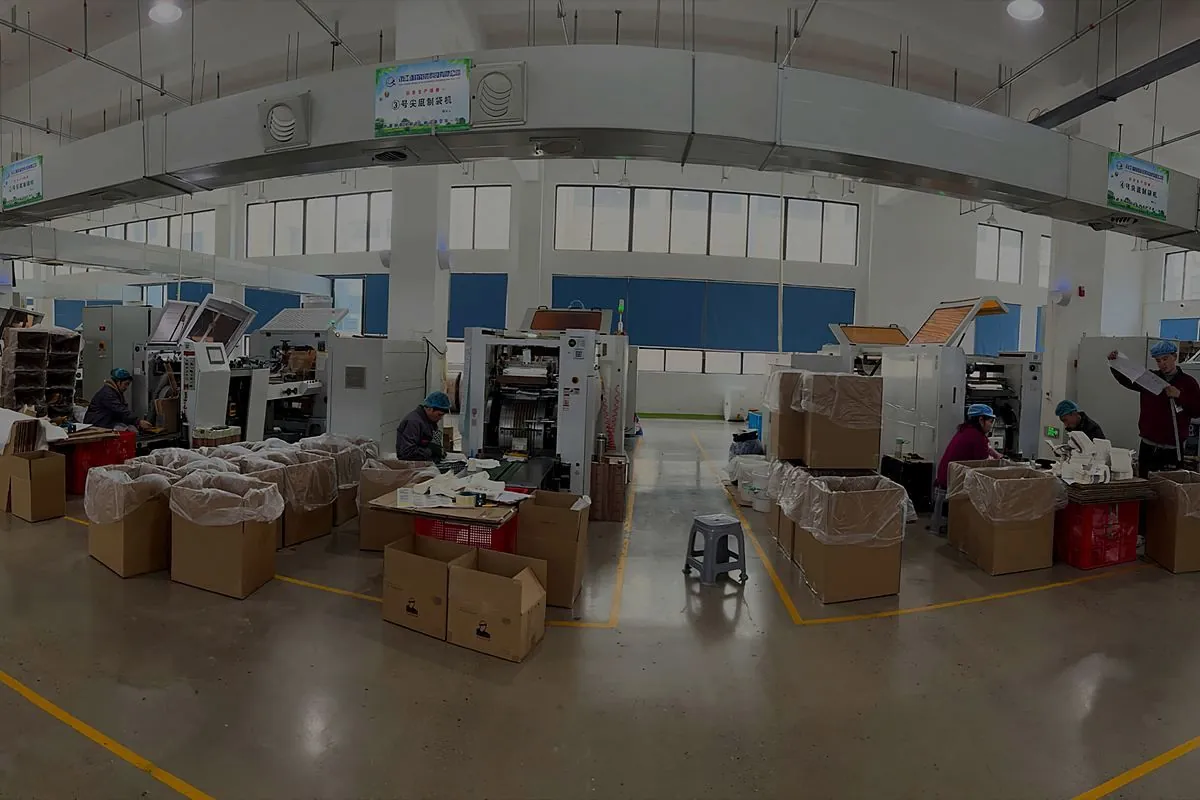
- Ask for a live video call, not a video. A pre-recorded factory tour is a stock asset. A call where you ask them to walk to a specific machine, start it, and hold a sheet of paper with today's date and your company name written on it proves the floor exists and is running that day.
- Read the business licence. Chinese business licences state a registered scope. Printing and packaging manufacture appears as words like 包装装潢印刷品印刷; a trading company's scope typically reads 货物进出口, 批发零售 or similar. Ask for the licence PDF, not a photo of the cover.
- Ask which steps are subcontracted. Almost every factory outsources something — lamination film, hot foil, sometimes die-cutting. The answer tells you where lead time and quality risk actually live, and a supplier who claims "everything in-house, we do nothing outside" is either very large or not being straight with you.
2. What they really make in-house
Paper bag production is a chain of about eight steps: paper slitting, printing, lamination, die-cutting, handle making, gluing/forming, inspection, packing. Ask which of those happen on their own floor.
Why it matters in practice:
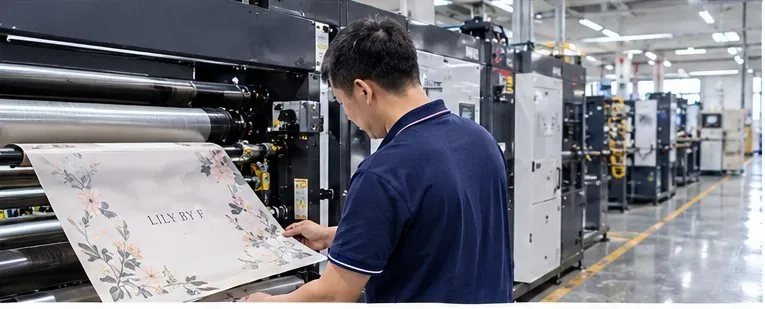
- Printing method sets your artwork options. Flexo handles up to about six spot colours cheaply at volume but cannot reproduce photographs; offset CMYK gives photo quality on art paper at a higher setup cost. A supplier who only says "we can print anything" has not looked at your file.
- Lamination in-house means tighter colour control. Matte or soft-touch film changes how your brand colour reads. If lamination is outsourced, colour can drift between batches and nobody owns it.
- Handle production affects strength. Twisted paper, cotton rope, ribbon, die-cut and PU leather handles are made on different equipment. If they only offer two types, your design may be forced into a compromise.
3. MOQ and sampling terms
A meaningful MOQ is quoted per design, not per order. Ask directly:
- What is the MOQ for this exact construction, size and colour count?
- Does the MOQ change if I use a stock size and stock paper?
- Is the sample hand-made or pulled from a real production run?
- Is the sample fee credited back against the bulk order, and at what quantity?
A hand-made sample can look better than what a production line will actually deliver — thinner glue lines, hand-cut edges, careful alignment. Ask for a sample produced on the same equipment that will run your order, and keep it. It becomes your reference standard if the bulk goods are disputed.
Typical ranges for custom printed bags run from 500 pieces for a simple one-colour kraft bag to 3,000 pieces for a laminated bag with foil and embossing. Full detail is in our MOQ guide.
4. Quality control you can audit
"We have strict QC" is not information. These are:
- Who inspects, and against what. A named person, an AQL level (AQL 2.5 is common for retail packaging), and a written defect list.
- 100% inspection on the failure-prone steps. Handles and glued seams are where bags actually fail. Sample-based inspection misses a weak glue joint on bag 1,400 of 5,000.
- Pre-shipment photos or video. Random cartons opened on camera, with the packing list visible.
- Records you can ask for. Batch number, paper lot, ink lot, and who signed off. If a supplier cannot tell you which batch your order came from, they cannot trace a problem either.
Two tests worth running yourself on the first delivery:
- Weigh a sheet. An A4 sheet of 150 gsm paper weighs about 9.4 g, 250 gsm about 15.6 g. If the 250 gsm bag you ordered feels light, a kitchen scale settles the argument in ten seconds.
- Load and lift. Fill a bag to the weight it is meant to carry, lift it by the handles and hold for 30 seconds, then repeat twenty times. Handles should not tear at the eyelet, and the top edge should not distort.
5. Export and compliance experience
Ask which countries they ship to most, and which port they load from. A supplier shipping to your region weekly knows the paperwork, the transit time and the customs quirks; one shipping there twice a year does not.
Then ask a compliance question specific to your market. Packaging rules have tightened nearly everywhere: the EU's packaging and packaging waste framework, extended producer responsibility fees in many member states, and a patchwork of state and city rules in the US. You do not need your supplier to be a lawyer — you need them to know which papers, inks and adhesives are commonly specified for your market, and to say "let me check" instead of guessing.
6. How to read a quotation
Ask for the quote to be broken down into: paper and board, printing (including plate or cylinder charges), lamination or varnish, handle, additional finishing, packing, and the Incoterm with port. Two quotes that look 20% apart are usually not the same product.
Where cost quietly hides:
- Paper weight substitution — 210 gsm instead of 250 gsm is invisible until you hold two bags side by side.
- Recycled or mixed pulp replacing virgin kraft, which prints duller and tears more easily at the handle.
- Thinner lamination film, which scuffs in transit.
- Fewer glue points, which shows up as bags opening at the base three weeks later.
- Plate charges moved into "tooling" and appearing only after you commit.
A suspiciously cheap quote is not a discount. It is a specification you have not been told about.
For the full anatomy of a paper bag price — and the six questions that make two quotes comparable — see Custom Packaging Cost Breakdown.
7. Six questions and the answers to listen for
| Question | A credible answer | Warning sign |
|---|---|---|
| Can we do a video call on the production floor? | "Yes, here is a time slot — tell me which machine you want to see." | Repeated rescheduling, or only photos. |
| Which steps do you subcontract? | A specific list, with lead-time impact. | "Everything is in our own factory." |
| What is the MOQ for my exact spec? | A number per design, plus what changes it. | One flat number for every product. |
| What happens if the goods arrive out of spec? | A written remedy: remake, credit, or replacement on the next run. | "That never happens." |
| Who is my contact after the order is placed? | A named person with a direct channel. | A rotating shared inbox. |
| Can I see the inspection record for my batch? | Yes, with date and inspector. | Only a verbal "all good". |
8. How to run a low-risk trial order
Do not start with your biggest programme. Start with the smallest order that reveals how the supplier behaves:
- One design, one size, 500–1,000 pieces, artwork you already have.
- Pay for the sample. Approve it in writing, with photos, and keep the signed-off sample.
- Watch three things during the run: does the delivery date hold, does the bulk match the sample, does anyone tell you proactively when something slips.
- Test the goods yourself — the sheet weight and the handle lift above.
- Only then scale to 10,000 or 50,000 pieces.
The most expensive supplier is not the one quoting 8% more. It is the one whose reprint you have to pay for in December.
9. Red flags, in order of severity
- Pressure to pay a large deposit before any physical sample exists.
- No fixed contact person, only a rotating sales inbox.
- No business licence, or one whose scope does not mention printing or packaging.
- Quotes that cannot be broken down by material, printing and finishing.
- Samples that arrive faster than physically possible for the stated construction, and look suspiciously better than the bulk.
- Prices below the cost of the paper itself at current market rates.
Where Boxelan fits
We are a printing and packaging factory in Zhenkou, Dongguan — not a trading company. Flexo and offset printing, die-cutting, lamination, handle making and inspection all run on our own floor; our address and business scope are on the factory section of the homepage. MOQ is 1,000 pieces per design, samples take 3–5 days, and production runs 10–20 days after approval.
If you are comparing suppliers, ask us the six questions above. We would rather lose an order at the quoting stage than argue about a batch at the port.
Frequently asked
How do I know if a supplier is a factory or a trading company?
Ask for a live video call with the machines running and a sheet of paper on the floor with today's date and your company name written on it. Ask which production steps they do in-house and which are subcontracted. A trading company can answer neither question convincingly, and their business licence will usually list trade or consulting rather than printing and packaging manufacture.
What is a normal MOQ for custom printed paper bags?
For custom-printed bags with your own artwork, most Chinese factories quote 500 to 3,000 pieces per design. Simple kraft bags with one-colour printing sit at the low end; laminated luxury bags with foil, embossing or special handles sit at the high end. Below 500 pieces, most factories either refuse or price the order as a sample run.
Should I pay a deposit before seeing a sample?
No. Pay for the sample itself (usually a modest fixed fee, often credited back against the bulk order), approve the physical sample, and only then pay the production deposit. A supplier who demands a large deposit before any physical sample exists is asking you to carry all the risk.